Access
Download
Download the Max Patch from here.
The latest version is available at the github repository below.
Installation
Unzip the downloaded file and place the Markov_Groove_Device.maxpat file in you Max X/Packages folder.
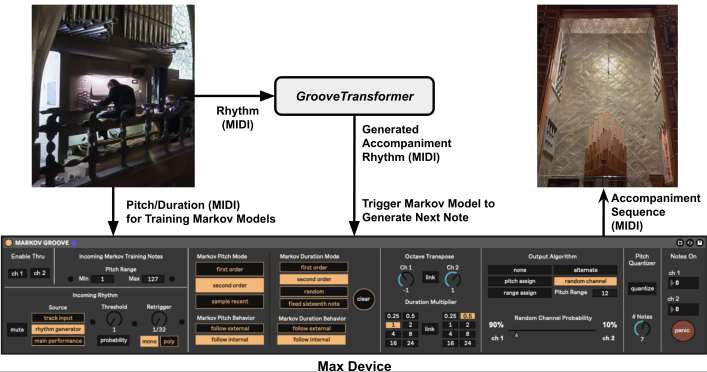
To drive the Markov Accompaniment patch, you will need a rhythmic source to drive the generations. Originally, the patch was developed to be used with the GrooveTransformer VST. You can use the GrooveTransformer VST to generate rhythmic patterns, or you can use any other rhythmic source that outputs MIDI notes.
Template Ableton Live Set
We’ve prepared an Ableton Live set that includes the Markov Accompaniment patch with all the required routings. You can download it from here.
Source Code
Availabe at https://github.com/evans398/markov-groove
License
Licensed under the GNU General Public License v3.0 (GPLv3).
Publication
Repurposing a Rhythm Accompaniment System for Pipe Organ Performance
Proceedings of the International Conference on New Interfaces for Musical Expression (NIME) · 2025Abstract
This paper presents an overview of a human-machine collaborative musical performance by Raül Refree utilizing multiple MIDI-enabled pipe organs at Palau Güell, as part of the Organic concert series. Our earlier collaboration focused on live performances using drum generation systems, where generative models captured rhythmic transient structures while ignoring harmonic information. For the organ performance, we required a system capable of generating harmonic sequences in real-time, conditioned on Refree’s performance. Instead of developing a comprehensive state-of-the-art model, we integrated a more traditional generative method to convert our pitch-agnostic rhythmic patterns into harmonic sequences. This paper details the development process, the creative and technical considerations behind the final performance, and a reflection on the efficacy and adaptability of the chosen methodology.
BibTeX
@inproceedings{nime2025_16,
  address = {Canberra, Australia },
  articleno = {16},
  author = {Evans, Nicholas and Haki, Behzad and Jordà, Sergi},
  booktitle = {Proceedings of the International Conference on New Interfaces for Musical Expression (NIME)},
  doi = {10.5281/zenodo.15698807},
  issn = {2220-4806},
  month = jun,
  numpages = {5},
  pages = {116--120},
  title = {{Repurposing a Rhythm Accompaniment System for Pipe Organ Performance}},
  track = {Paper},
  year = {2025},
}
Exploring Situated Stabilities of a Rhythm Generation System Through Variational Cross-Examination
· 2025Abstract
This paper investigates GrooveTransformer, a real-time rhythm generation system, through the postphenomenological framework of Variational Cross-Examination (VCE). By reflecting on its deployment across three distinct artistic contexts, we identify three stabilities: an autonomous drum accompaniment generator, a rhythmic control voltage sequencer in Eurorack format, and a rhythm driver for a harmonic accompaniment system. The versatility of its applications was not an explicit goal from the outset of the project. Thus, we ask: how did this multistability emerge? Through VCE, we identify three key contributors to its emergence: the affordances of system invariants, the interdisciplinary collaboration, and the situated nature of its development. We conclude by reflecting on the viability of VCE as a descriptive and analytical method for Digital Musical Instrument (DMI) design, emphasizing its value in uncovering how technologies mediate, co-shape, and are co-shaped by users and contexts.
BibTeX
@misc{kotowski_2025_16946740,
  author = {Kotowski, Błażej and Evans, Nicholas and Haki, Behzad and Font, Frederic and Jordà, Sergi},
  title = {{Exploring Situated Stabilities of a Rhythm Generation System Through Variational Cross-Examination}},
  month = sep,
  year = {2025},
  doi = {10.5281/zenodo.16946740},
  url = {https://doi.org/10.5281/zenodo.16946740},
  address = {Brussels, Belgium},
}
Contact
Support, Bug Reports, and Feature Requests
Please use this GitHub Issues page.
Feedback, and Direct Contact
If you prefer to contact us directly, please contact Behzad Haki.
Collaborations
If you are interested in collaborating with us, please contact any of the authors.
Overview
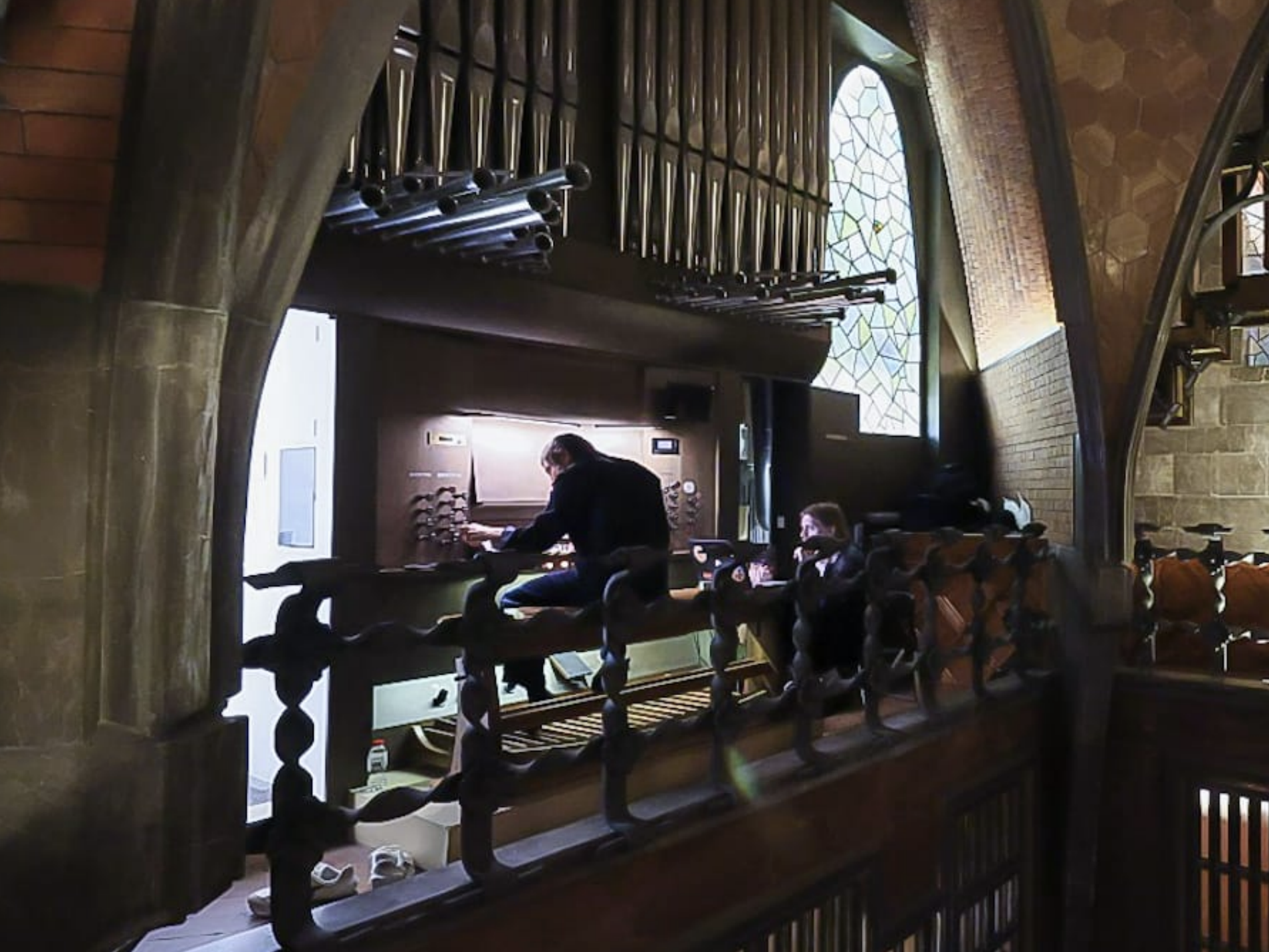
Back in November 2024, we had the opportunity to participate in a concert series at Palau Güell. These series, called Organic, were to showcase the main organ fixture of the venue, a large pipe organ designed specifically for the space.
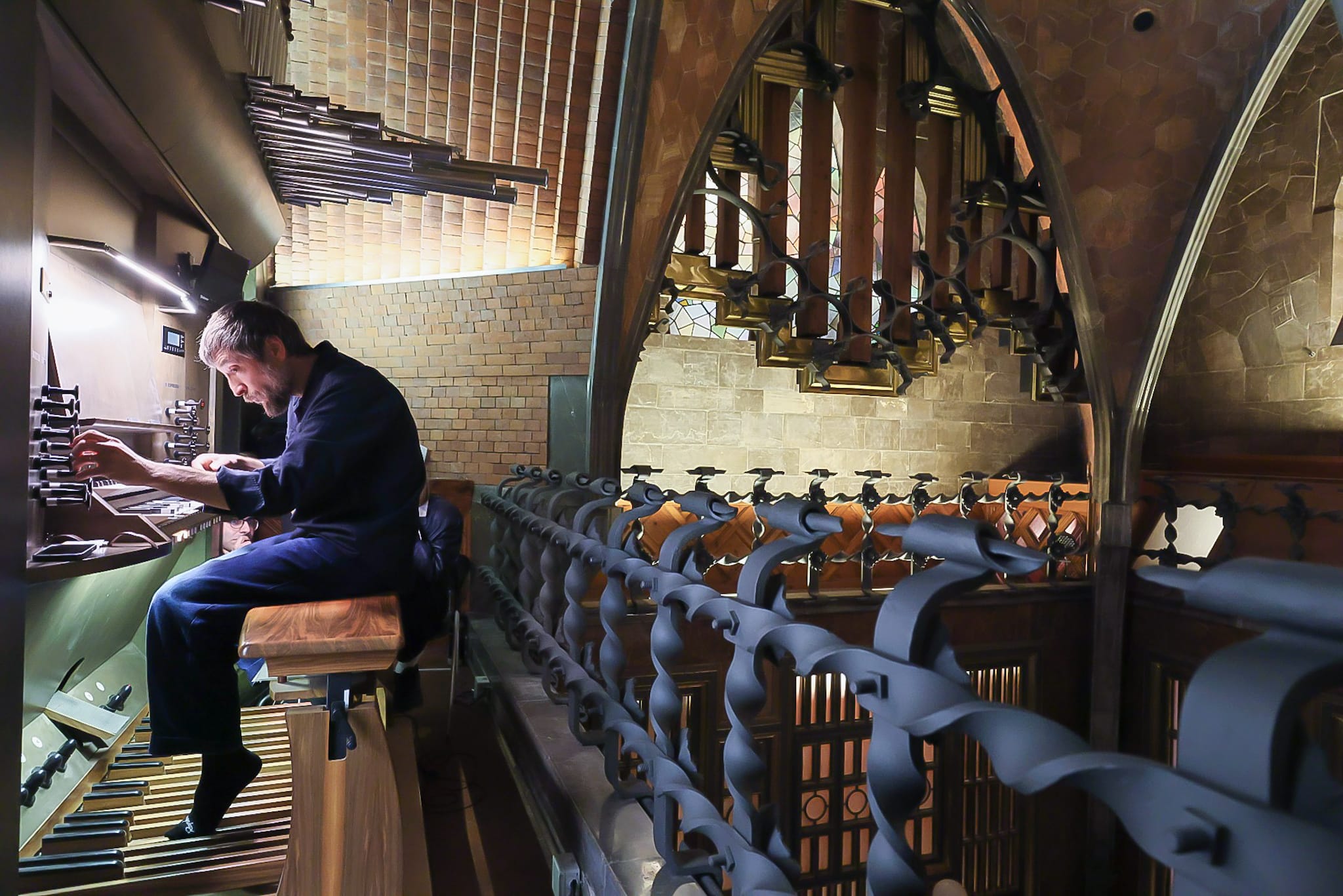
For this performance, we had access to the main organ, as well as a couple of portable organs (see image below).
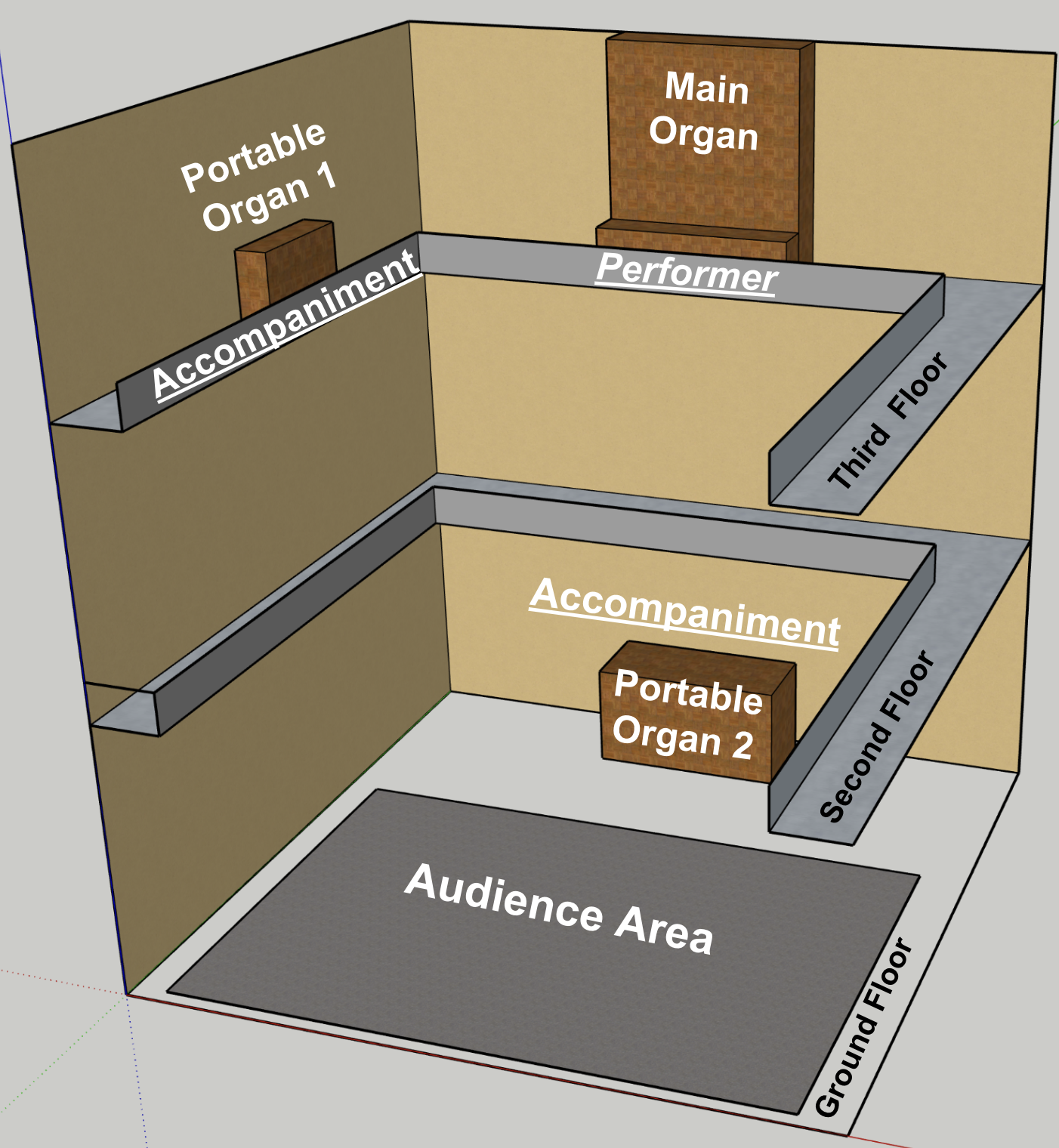
The concept for the performance was to us a setup in which Raul Refree would perform on the main organ, and the system would generate accompaniments in real-time, played by the portable organs.
The idea was to explore whether and how we could use our prior generative system, which were mainly focused on rhythm, to generate harmonic content for the organ. As such, we developed the system shown below, in which GrooveTransformer is used to generate rhythmic content and a Markov-model is used to generate the harmonic content.
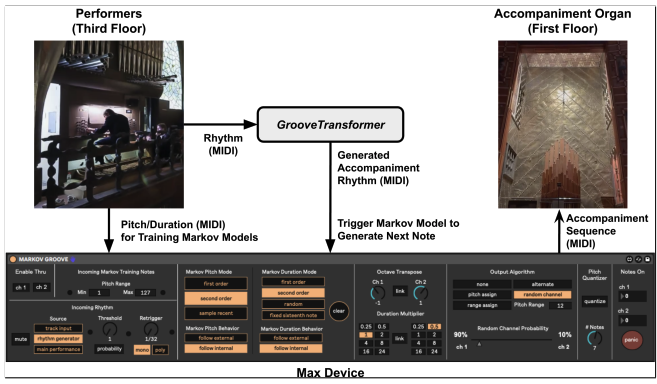
While the system was originally designed to work with the pipe organ, it can be adapted to work with any pitched instrument, digital or acoustic, that can be controlled via MIDI.
Documentation
The documentation for this Max4Live device is available at https://github.com/evans398/markov_compose/